Field notes / Experiment guide
Do chaotic ant territories become round?
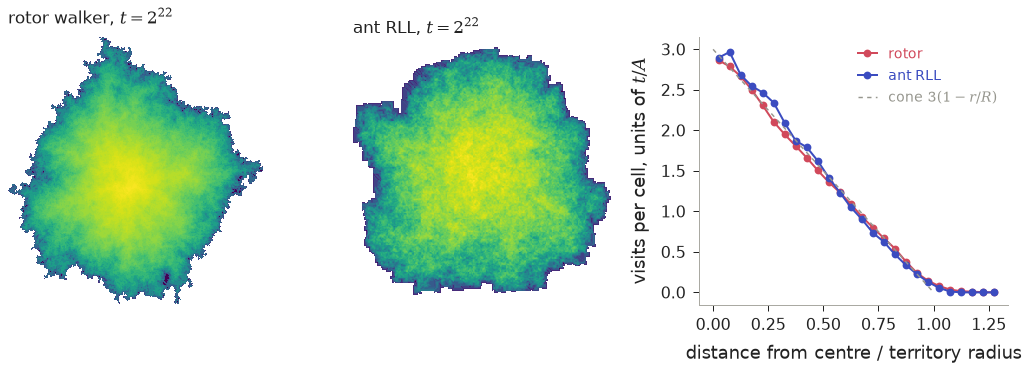
If the growth exponent is shared, do the territories also converge to a common shape and visit-density profile?
New to these ants? Start here.
An ant moves on a grid of coloured squares. Each colour tells it to turn left (L) or right (R). It advances that square to the next colour, then steps forward. A rule such as RLR is the list of turns, starting at colour zero. On a blank grid the same rule always makes the same trajectory.
Territory means every cell visited so far. Its boundary consists of visited cells with an unvisited neighbour. A highway is a repeating pattern of motion that carries the ant away. A tether means repeated returns to a small home region.
Growing like the cube root of time means taking eight times as many steps to double a linear size. The rotor walker is a comparison model that follows and rotates arrows stored on cells. A seed makes a random starting pattern reproducible; the ant itself can still move deterministically.
We distinguish c, the chance of discovering a cell per boundary step, from kappa (κ), time at the boundary normalized by perimeter divided by area. Explaining their values is harder than using them to account for growth.
A closer look
The idea under test
Anisotropy should diminish and scaled profiles should become more alike if a round limit emerges.
What we learned
The shape records compare ant ensembles with rotor controls and reveal why radius, boundary width and accumulated visit density need separate measurements.
What this leaves open
A finite collection of rescaled pictures cannot establish a unique limit shape. Rare breakouts can dominate ensemble moments.
Read the evidence and reproduction recipe ↗
Inside the experiment
Methods, registered predictions, exact commands and saved analysis. These are the working research documents; expand them for the detail behind the introduction.
Methods and original experiment record
shape-limit
Migrated legacy investigation (2026-10-14). Its files used to sit in the flat data/ directory (and calib/, occ/, snaps/, dumps*, knock* where listed) with the label prefix below; experiments/_migration/map.tsv gives the exact old -> new path of every file. This stub was generated from file names and script docstrings. It is not the original write-up: the question, timestamped hypotheses, commands and results are in notes/ (mainly notes/frontier-results.md, notes/frontier-status.md, notes/research-frontier*.md; search for the label), and the producing command is usually in the script docstring or a run_*.sh here.
Old labels / prefixes: shape
Scripts
scripts/shape_stats.py: Items 5 and 7: summarise examples/shape.rs output.
Results
8 entries in results/ (2 are .log/.done markers); csv/json/txt outputs, *_stats.txt hold the summaries quoted in the notes.
Notebook
No committed Jupyter notebook is available for this experiment yet.