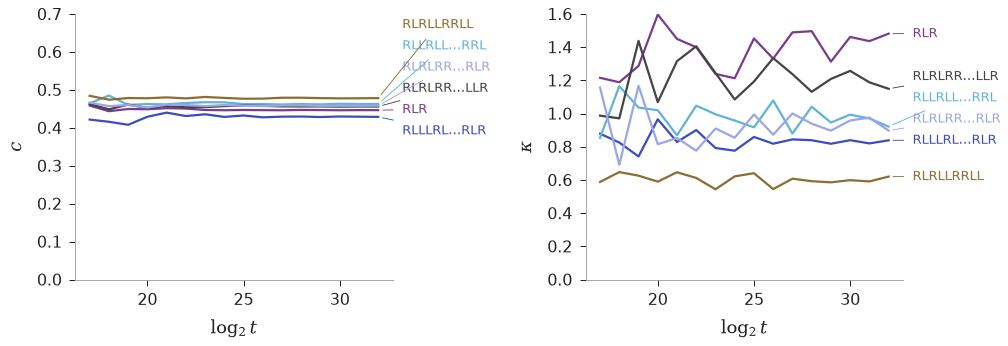
Which part of a rule controls access to fresh ground?
Rules with similar growth exponents still differ in time spent at the boundary. Can we predict that difference from the instructions themselves?
2026-10-kappa-rule-spaceWays into the research
What were we trying to understand? What did we expect? What happened? Start with the story and figures, then open the methods and notebooks when you want the detail.
104 experiments
Rules with similar growth exponents still differ in time spent at the boundary. Can we predict that difference from the instructions themselves?
2026-10-kappa-rule-space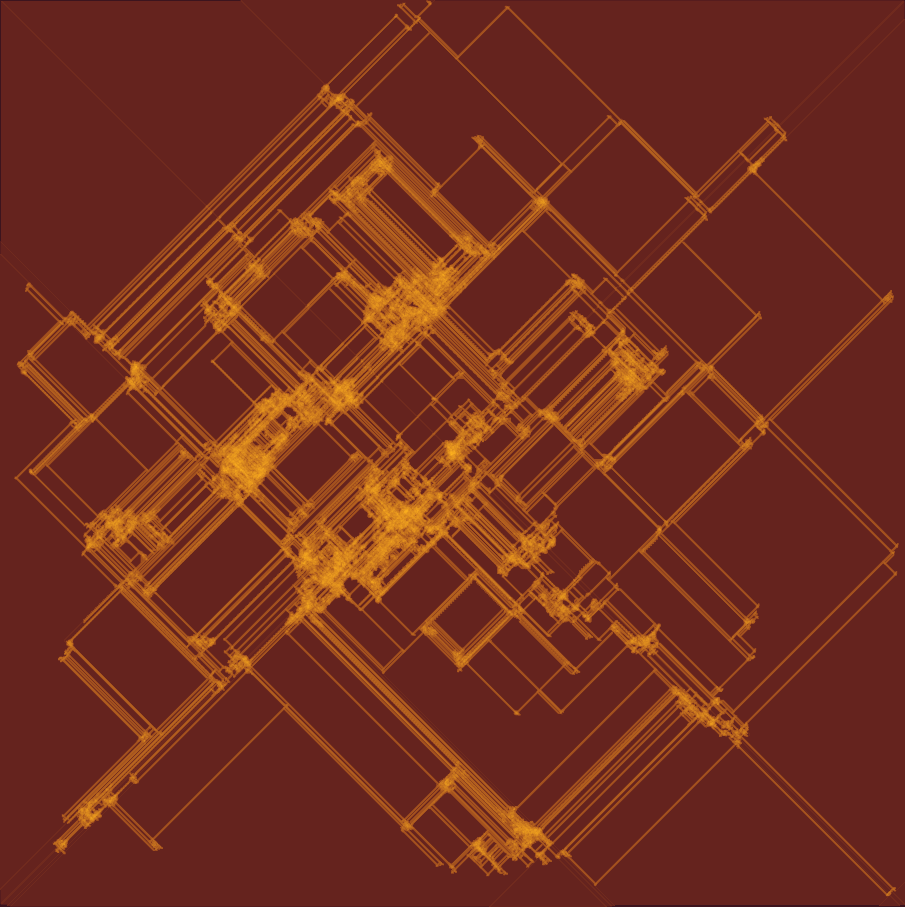
Some rules leave remarkably long diagonal rays. Are these self-sustaining travelling paths, repeated reversals or structures launched by a local spinner?
2026-10-crystal-rulesDoes circulation frequency explain why the birth-cost slope falls with loop length?
2026-10-20-lattice-c-law-coloursThe square-lattice opening-run law leaves its constants unexplained. Do changing loop length and neighbour count distinguish what sets them?
2026-10-20-lattice-c-lawIs the information about kappa specific to the first letters of a rule, or would the last letters or simple letter counts do as well?
2026-10-20-kappa-spread-featuresBoundary occupation varies a lot between rules. How much of that variance is start-to-start noise, how much can the rule opening predict, and how much is left?
2026-10-20-kappa-spread-budgetWhich part of the opening carries the prefix information: the lead, or the run structure of the first few runs?
2026-10-20-kappa-prefix-runsThe eight-letter prefix predicts held-out kappa. Is that a transferable letter-level rule, or do rules sharing an opening simply behave alike?
2026-10-20-kappa-prefix-family-holdoutThe eight-letter lookup carries information spread over letters 2-7. Would a model that adds up one effect per letter position do as well?
2026-10-20-kappa-prefix-additiveThe first eight letters of a rule predict held-out kappa. Is the information in a few early letters, or spread across them?
2026-10-20-kappa-prefix-ablationCan depth-crossing dynamics explain kappa on fresh starts, larger territories and unseen rule families?
2026-10-20-kappa-first-passageCan compressed phase memory reproduce the boundary birth process, beyond its mean cost?
2026-10-20-c-law-renewal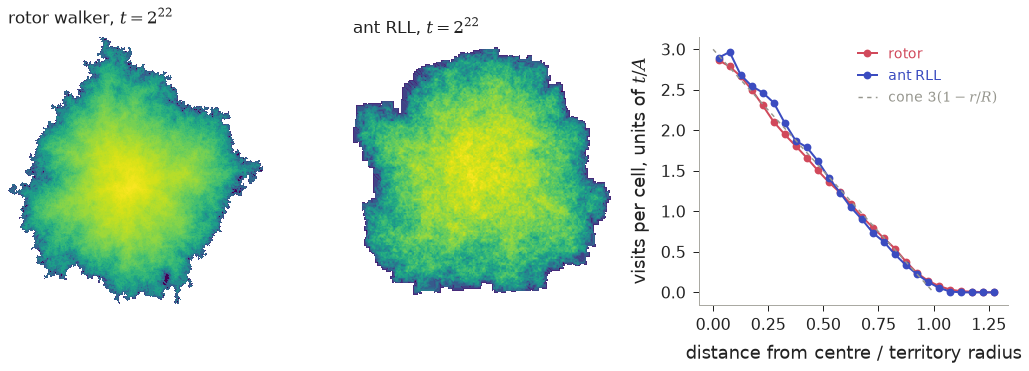
Ant boundary occupation sits below a simple uniform reference. Do rotor and random walkers also deviate when each gets its own growth-adjusted reference?
2026-10-19-kappa-walker-reference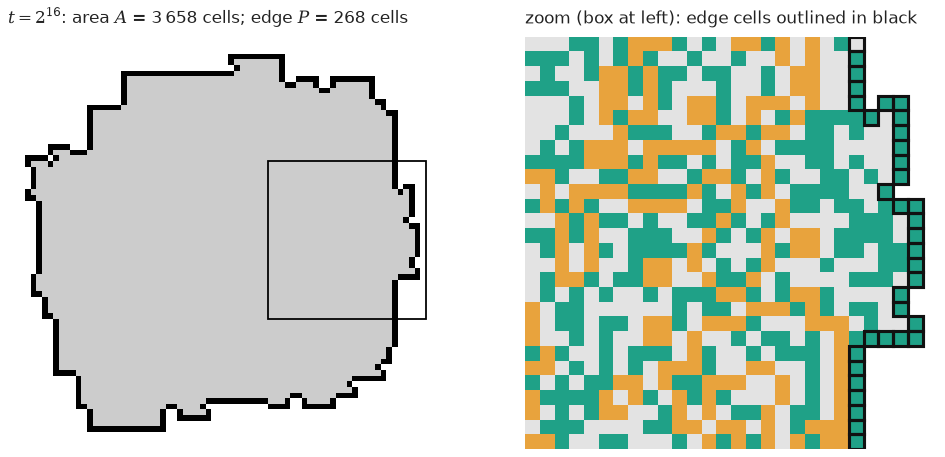
Does the start of the rule control boundary time directly, or primarily the chance of stepping onto fresh ground?
2026-10-19-kappa-chiral-edge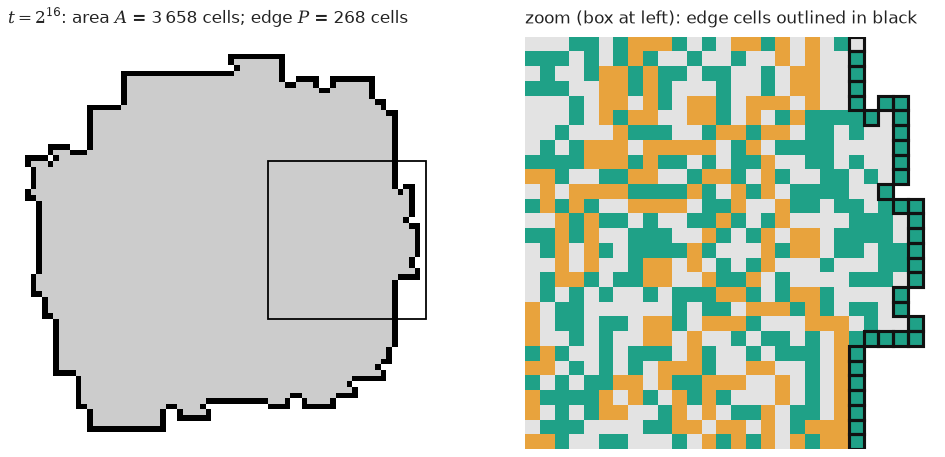
The number of boundary steps needed to discover a new cell is nearly linear in the rule’s opening-run length. Where does that law come from?
2026-10-19-c-law-mechanism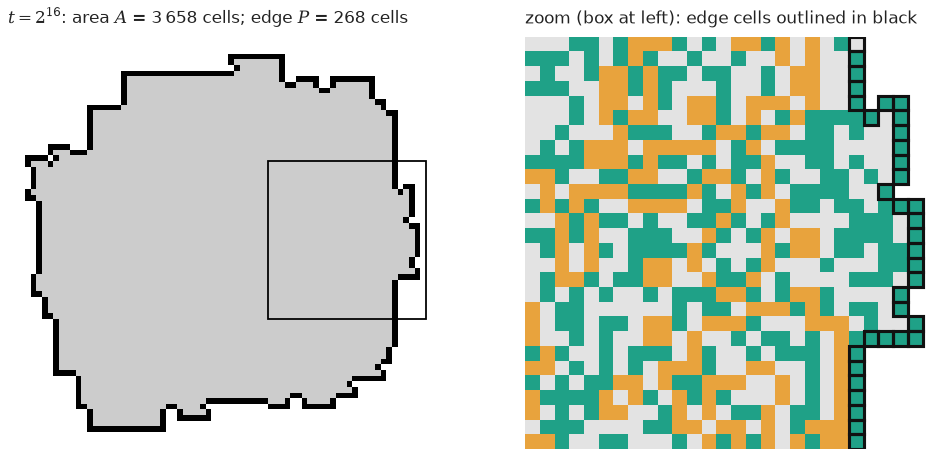
We normalize boundary time by perimeter divided by area. Should a walker that is uniformly spread over a growing territory therefore have kappa equal to one?
2026-10-16-kappa-uniform-baselineLong opening runs can make an ant circle small squares on young cells. Does that explain their apparent boundary-occupation effect?
2026-10-16-kappa-square-loopShort prefixes predict boundary occupation surprisingly well. Which simple feature of the prefix is carrying that information?
2026-10-16-kappa-prefix-decode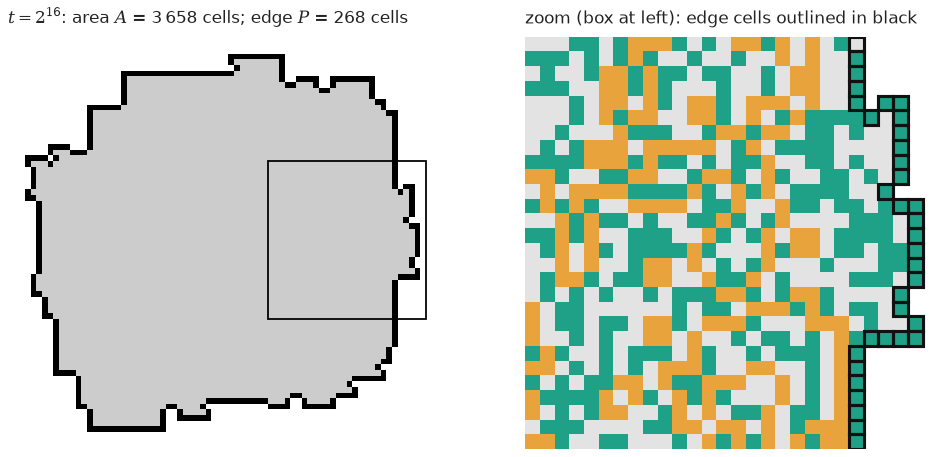
If short square loops keep an ant near the edge, would suppressing those loops change its boundary occupation?
2026-10-16-kappa-loop-surgeryA longer opening run of identical turns appears linked to boundary occupation after adjusting for area. Does it replicate on fresh rules, and does changing one letter reproduce it?
2026-10-16-kappa-leadrun-freshA rule’s initial run of identical letters predicts boundary occupation after area adjustment. Does using current rather than early area change that association?
2026-10-16-kappa-growth-clockCan the GPU produce the same full growth and shape measurements as the CPU probe for large batches of rules and seeds?
2026-10-16-gpu-probeCan a graphics processor accelerate a large census while returning exactly the CPU’s classifications and end-state statistics?
2026-10-16-gpu-ant-sweepWhich published results genuinely constrain our growth and boundary questions, and which similarities are only analogies?
2026-10-15-literature-reviewAn ant can spend most of its time away from the edge in a small number of long interior episodes. Is that tail budget the missing explanation?
2026-10-15-kappa-tail-budgetCould a few directional crossing patterns explain why some ants spend more time at the boundary?
2026-10-15-kappa-return-gatesChanging an early letter often has a larger effect than changing a late one. Does that happen because the boundary mostly exposes early colours?
2026-10-15-kappa-prefix-exposureMight the age and visit history of cells explain why ants differ in returning from the interior to the edge?
2026-10-15-kappa-field-ageMatched pairs suggest a relationship between extreme excursions and boundary occupation. Does a split-seed model find it across whole rules?
2026-10-15-kappa-cutoff-mixed-effects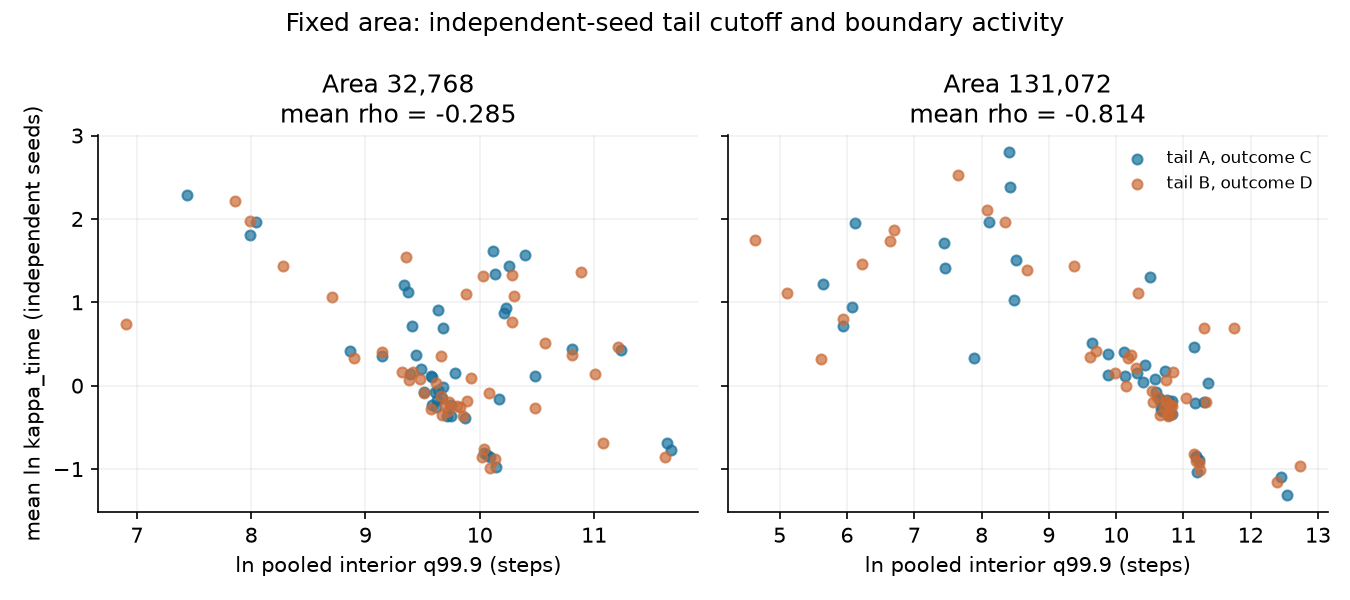
Could the excursion-cutoff association be an artefact of estimating area and both compared quantities from the same ant runs?
2026-10-15-independent-areaThe ant’s outer edge is broader than the rotor’s. Is that a slowly changing large-scale shape, or shorter-wavelength roughening?
2026-10-15-hull-checks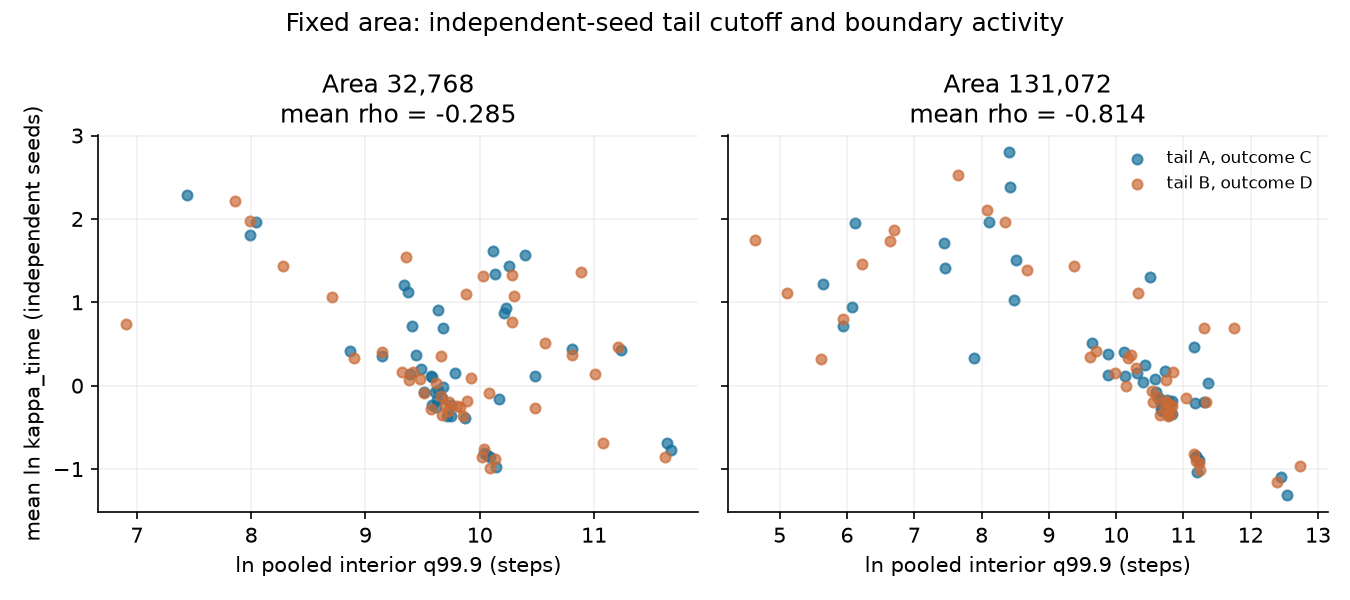
Does the connection between extreme interior excursions and boundary occupation survive comparing ants at the same visited area?
2026-10-15-fixed-area-cyclesA model relating turning bias to fresh-ground entry looks predictive. Does it explain more than a few early rule letters already tell us?
2026-10-15-chirality-baselines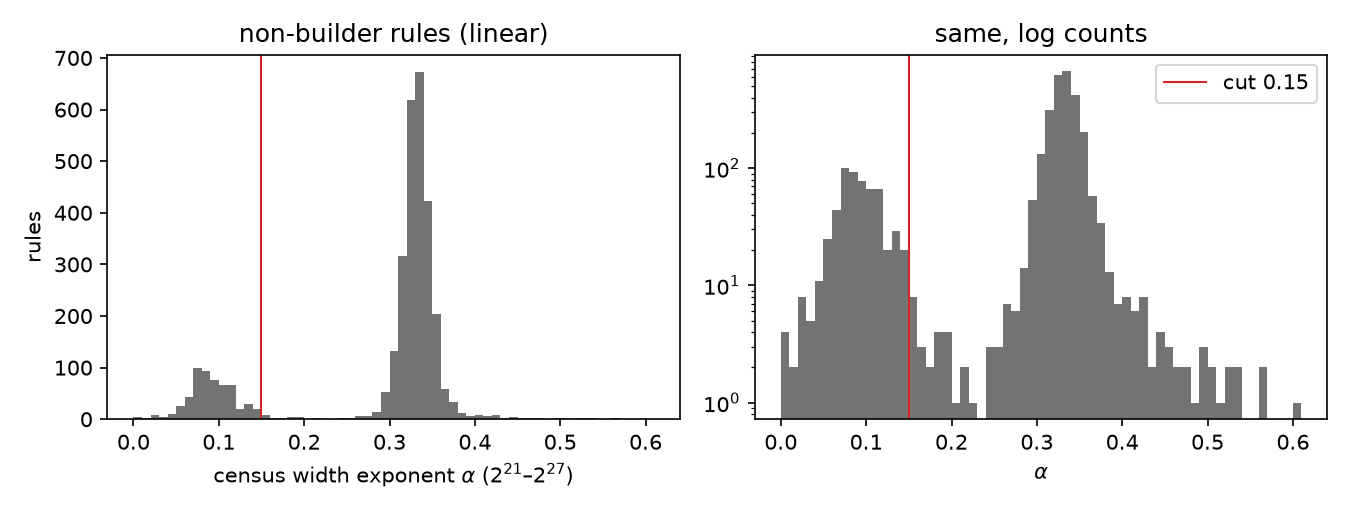
The census separates very slow rules from a broad compact-growth peak. Does the headline exponent depend on exactly where we draw the cut?
2026-10-15-alpha-gapWhen an ant leaves the edge, how do its longest interior excursions relate to its eventual boundary occupation?
2026-10-14-t1-excursion-tomographyOne rule (RLLLLLLLRRLRR) leaves most cells visited exactly twice and draws nested 45-degree rectangles. What property of a rule produces that, and is it a different growth class?
2026-10-14-rulepatBoundary occupation and territory area are tied by growth. Is there a rule-specific difference left when similarly sized territories are compared?
2026-10-14-kappa-matched-area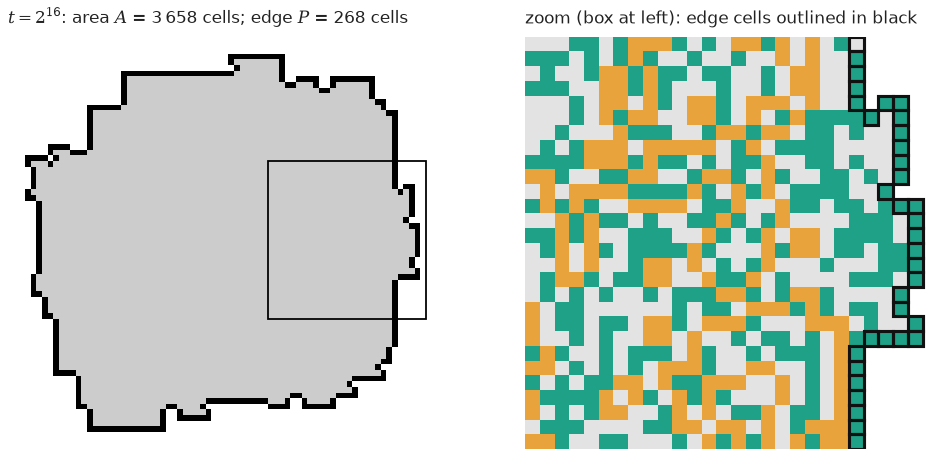
Surface cells include the rims of holes inside the territory. Could those holes explain the ant’s broader boundary compared with the rotor?
2026-10-14-hull-widthDo ant perimeters approach square-root-of-area scaling, or retain a genuinely different exponent from the rotor?
2026-10-13-w4-edge-exponent-2e36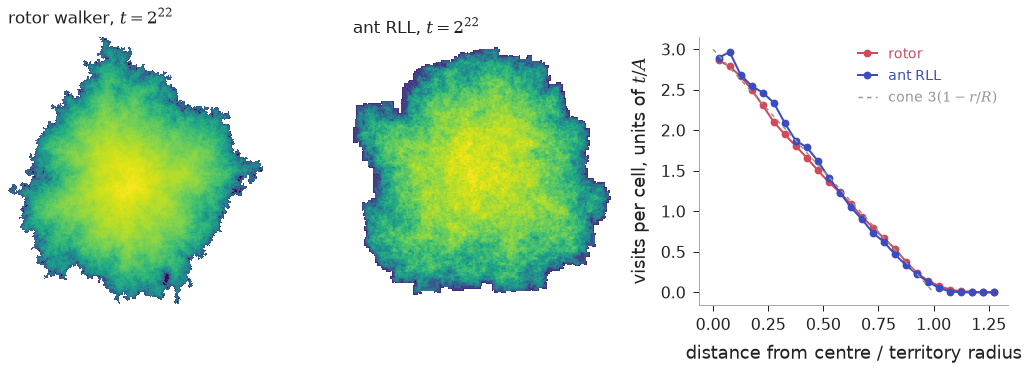
The accumulated cone follows under particular occupation and growth assumptions. Does it survive when noise changes a rotor’s growth law?
2026-10-13-w3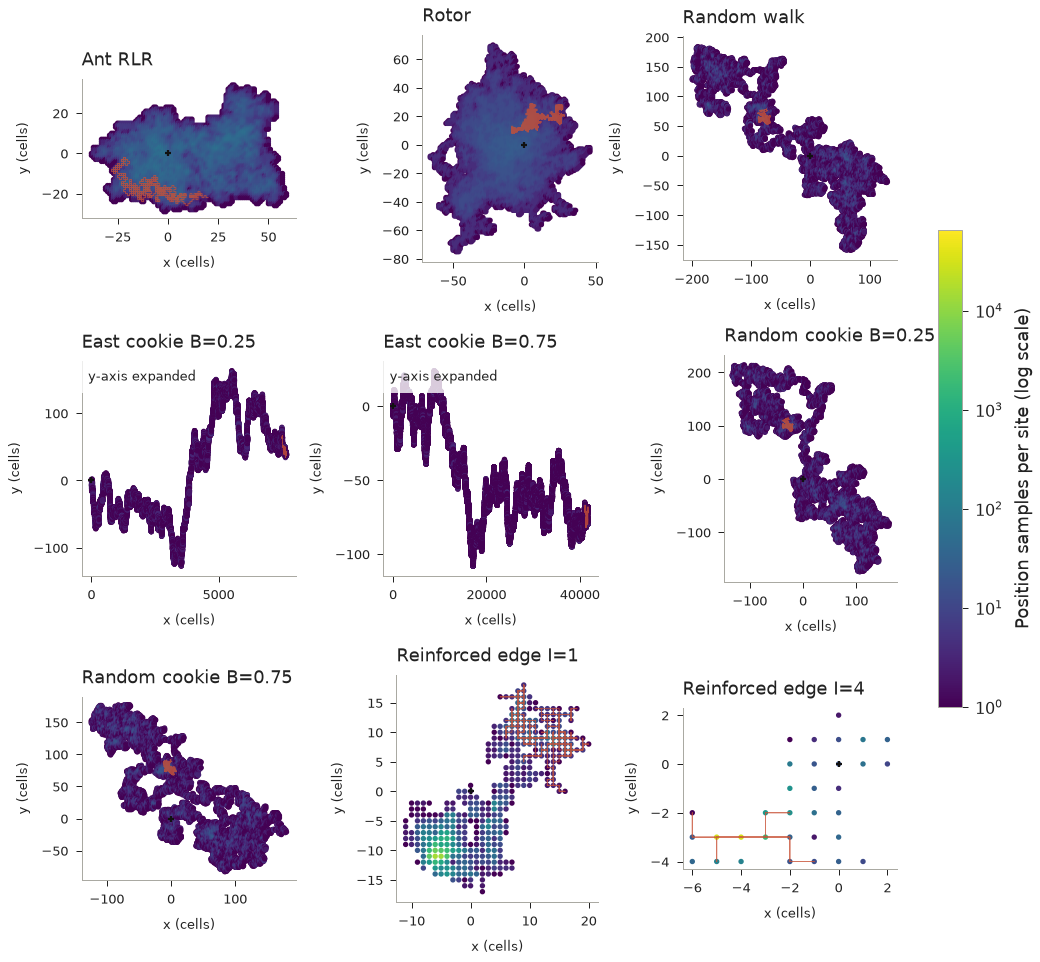
Can the radial visit-density argument be carried over to stateful walkers with square-root-like growth?
2026-10-13-w2Some territories look as though they have a distinct outer layer. Does that visible structure predict how much time the ant spends near fresh ground?
2026-10-13-w1Are comparisons of boundary-width exponents robust to fitting against radius rather than clock time?
2026-10-13-w-width-radius-refitDoes a measured transport budget remain useful when we carry it forward to a later window instead of reconstructing the same window?
2026-10-13-transport-forecast
Is tethering an isolated curiosity, or a recurring kind of behaviour among very slow-growing rules?
2026-10-13-tether-rules
How can an ant keep returning to a small neighbourhood while its visited region continues to grow?
2026-10-13-spread-home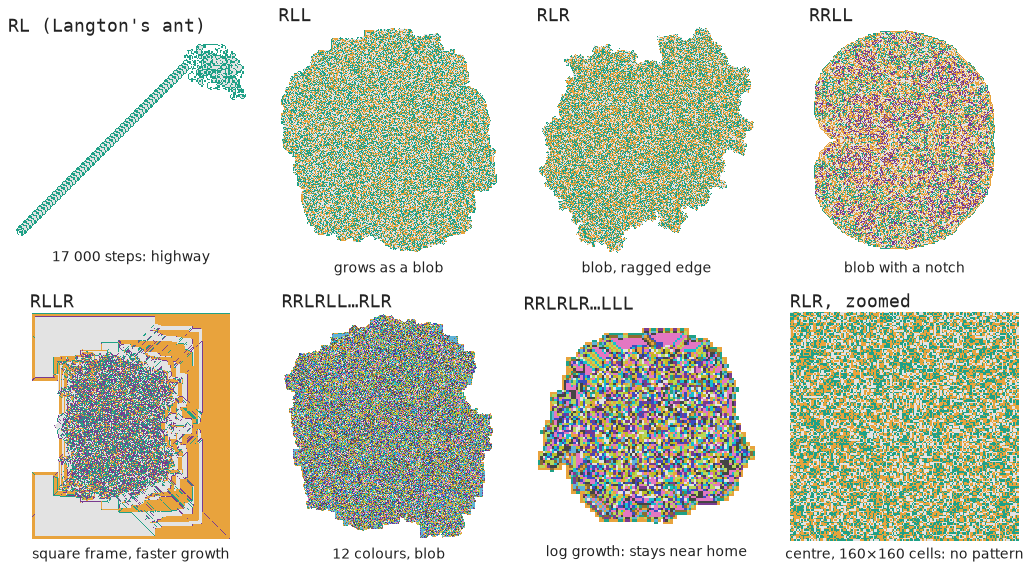
How different can the visited territories look when the only instruction is a repeating string of left and right turns?
2026-10-13-snapshots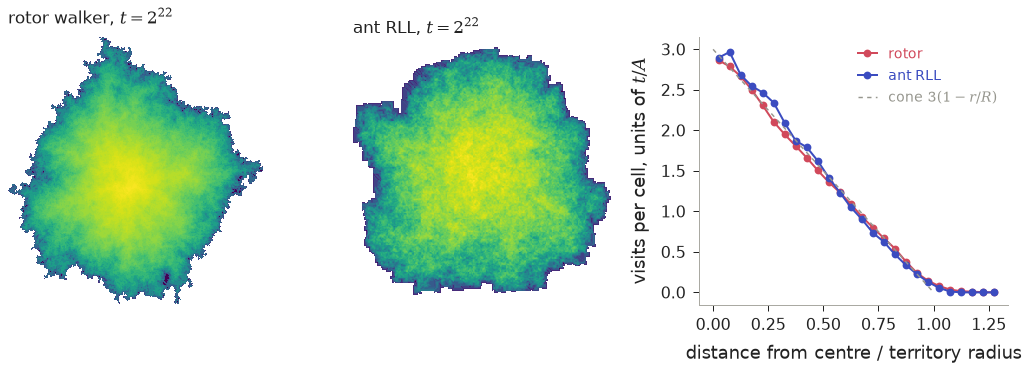
If the growth exponent is shared, do the territories also converge to a common shape and visit-density profile?
2026-10-13-shape-limitRare colours look important to tethering. Is changing those colours more damaging than changing the same number of arbitrary cells?
2026-10-13-recolourThe ant’s boundary width grows faster in time than the rotor’s. Does the difference survive measuring width against territory radius instead?
2026-10-13-r1-width-vs-radius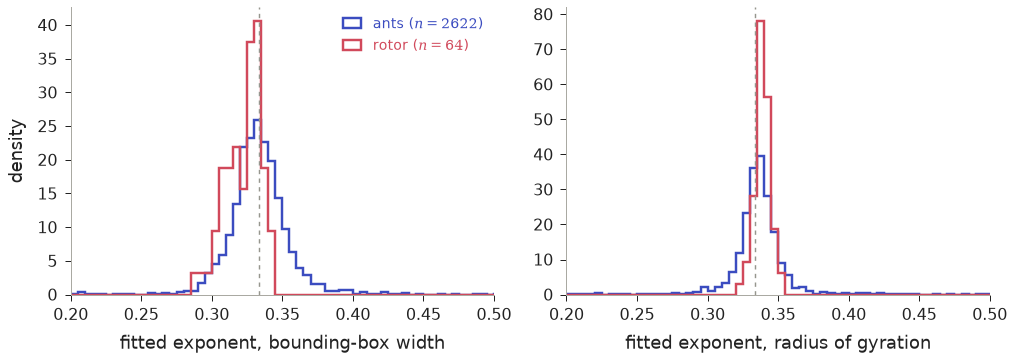
How broadly does cube-root-like growth occur among generalised Langton’s ants, and what distinguishes slower and faster cases?
2026-10-13-probe-growth-census
How does the colour field left by an ant affect the motion of an ant started on it later?
2026-10-13-patterns-fieldsThe blank-board ant is deterministic. Does a small random starting patch change its large-scale growth, or mainly the particular path?
2026-10-13-patched-starts
A picture of visited cells hides how unevenly the ant uses them. What do occupancy maps reveal about compact growers and tethered rules?
2026-10-13-occupancy-pages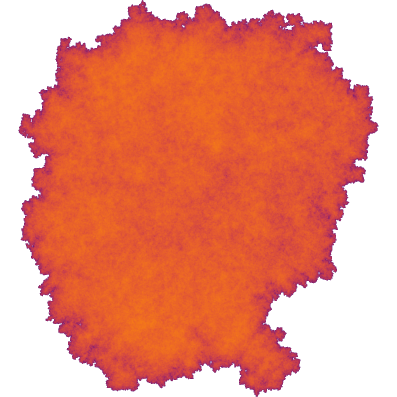
A deterministic ant often looks like a random walker in the interior. Do its colours, turns and short-lag motion support that picture?
2026-10-13-mixingCan the project’s exploratory instruments measure trajectory structure and run large sweeps without changing the walk?
2026-10-13-misc-instruments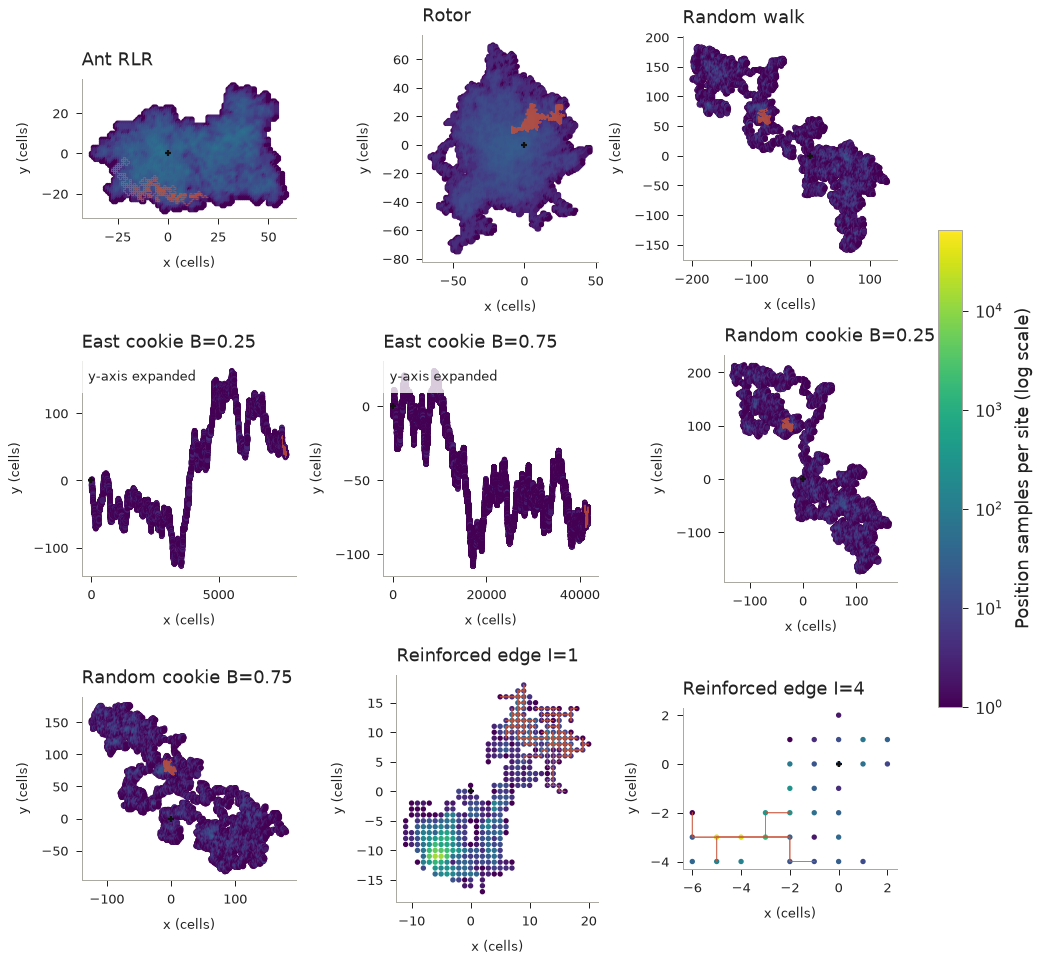
The ant writes information into the grid and later responds to it. Which parts of its growth can simpler memory-based walkers reproduce?
2026-10-13-memory-walkers
Why do some rules add territory so slowly while continuing to move almost all the time?
2026-10-13-log-growersWhat does the spatial arrangement of colours reveal that an overall histogram misses?
2026-10-13-layers-coloursA rule’s letters can be arranged around a cycle. Does rotating that cycle preserve boundary occupation, or is the first colour special?
2026-10-13-k1-necklace-iccAn ant may stay close to home most of the time while rare excursions enlarge its historical territory. Which notion of radius captures that distinction?
2026-10-13-j4-tethered-gyration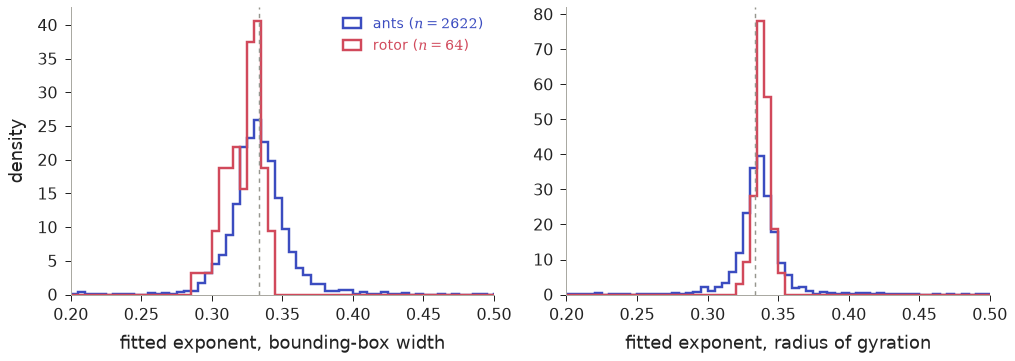
Is the narrow exponent peak evidence that different chaotic rules share exactly the same growth law?
2026-10-13-item4-exponent-rotor-calibratedThe census contains rules far from the central growth-exponent peak. Do they remain unusual under new starting patterns?
2026-10-13-item21-slow-outliers
The knockout maps identify sensitive patches. Do unusual colour classes help explain why those particular patches matter?
2026-10-13-hot-tilesHow many short rules that survive an initial census later find a repeating escape path?
2026-10-13-highways-unresolved-rules-1e10-1e11Rules grow territories at different rates. Can rescaling by measured boundary factors bring their growth curves together?
2026-10-13-h3-scaling-collapseTwo territories can have the same width but different numbers of visited cells. Does changing filling fraction explain why their area exponents differ?
2026-10-13-h1-lacunarity-decomposition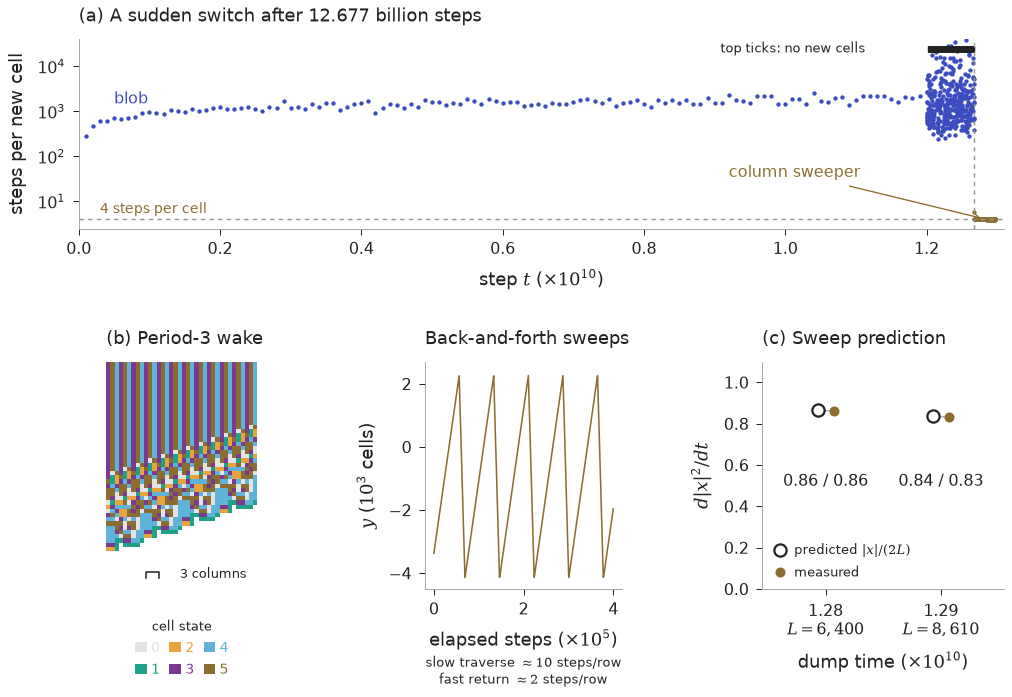
RLRLLL looks like a compact chaotic grower for billions of steps, then begins sweeping columns. What changes at that late transition?
2026-10-13-g1-ribbon-breakoutWhich simulation and analysis tools are needed to turn the project’s frontier questions into reproducible tests?
2026-10-13-frontier-code-patch
A fresh ant moves differently on an old field than on a scrambled copy. At what field age does this difference emerge?
2026-10-13-formage-ageA deterministic trajectory can change completely after one altered cell. Must its large-scale habit of staying home change too?
2026-10-13-flip-damage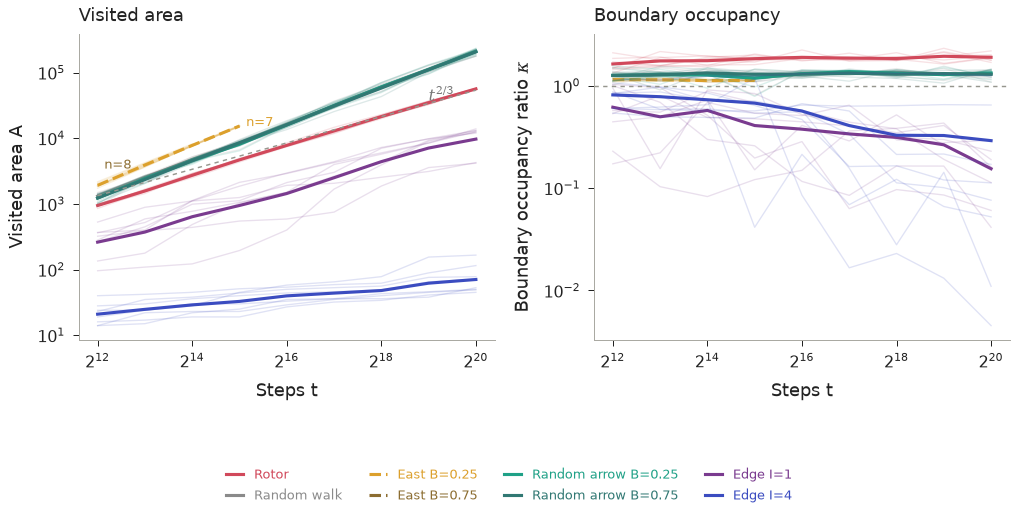
Is the observed growth peculiar to one ant on a square grid, or does it recur on other lattices and in related walkers?
2026-10-13-ext-other-lattices-turmites-noise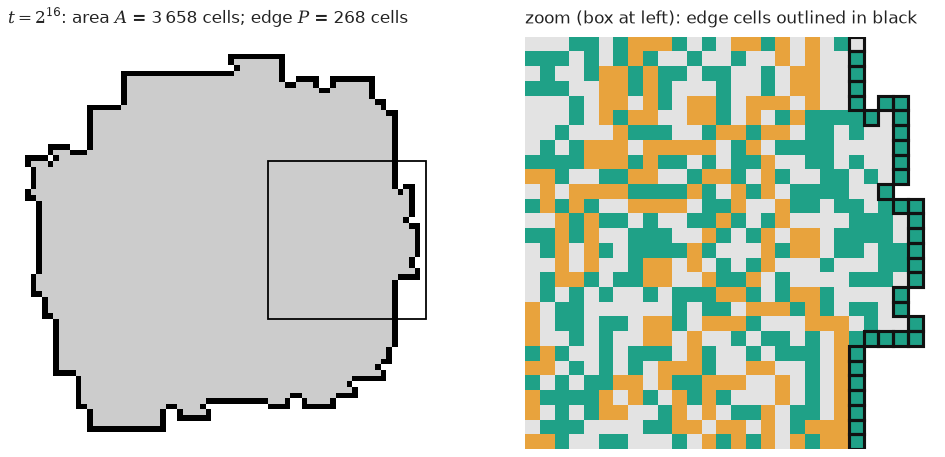
Territory growth combines time spent at the boundary with the chance of entering fresh ground once there. Which part varies with the rule?
2026-10-13-edge-statisticsAre a mature tether’s sensitive regions already doing the same job early in the trajectory?
2026-10-13-e6-hot-window-ageThe first sensitive-patch maps concern only two rules. Do similar small hot regions appear in other tethered ants?
2026-10-13-e5-more-knockout-mapsIs losing the tether determined only by how many rare-colour cells an intervention changes?
2026-10-13-e4-patch-vs-swapDo sensitive patches guide the ant home specifically, or are they simply places the ant visits frequently?
2026-10-13-e3-route-collinearityDoes the apparent size of a tether’s important region merely reflect the radius used to define a return home?
2026-10-13-e2-sensitive-discA tether’s sensitive cells appear in a one-sided lobe. Is that orientation fixed by the rule or inherited from the particular colour field?
2026-10-13-e1-one-sided-hot-regionTethered ants stay near home on their own mature colour fields. How gradually does that behaviour disappear as the field is scrambled?
2026-10-13-dose-corruption-doseWhat changes when several ants edit the same colour field: the growth law, or mainly how much total stepping has been done?
2026-10-13-d4-many-antsThe ant’s movement is deterministic. If we occasionally replace its prescribed turn, does its territory abruptly become random-walk-like?
2026-10-13-d3-noiseIf revisiting old territory slows a two-dimensional ant, what growth should a related walker show in three dimensions?
2026-10-13-d2-three-dimensionsAdding an internal state produces many walkers with square-root-like area growth. Are they compact territories with a new exponent, or thin structures?
2026-10-13-d1-turmite-sqrt-clusterColours record visit counts modulo the rule length. Are their spatial mixtures uniform, or does the edge retain a distinct signature?
2026-10-13-colourstats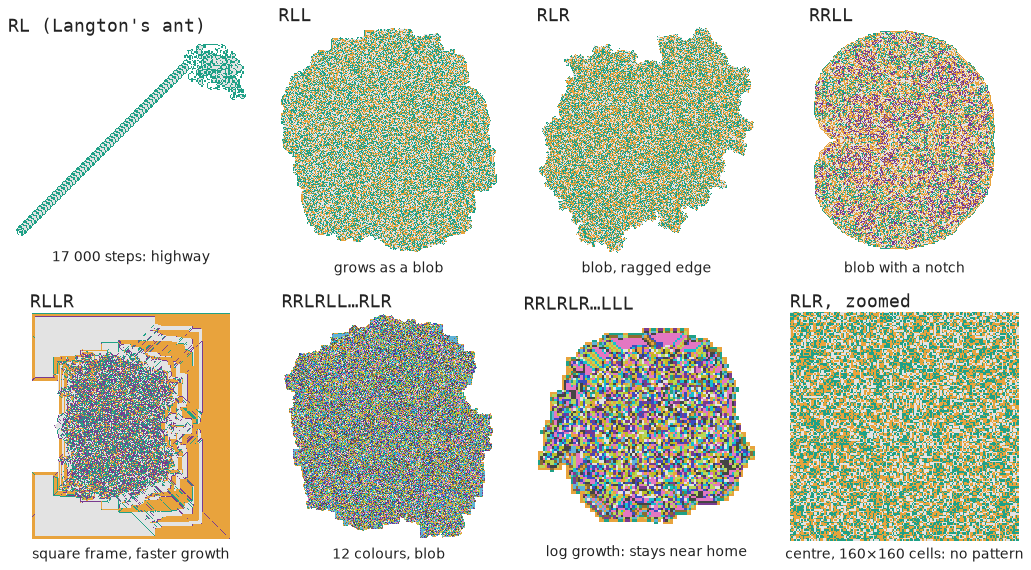
What kinds of long-run behaviour emerge when we enumerate short left/right rules instead of choosing a few attractive examples?
2026-10-13-census-sweepsAfter sensitive patches have been found, does the ant’s return behaviour depend on individual cells within them?
2026-10-13-cell1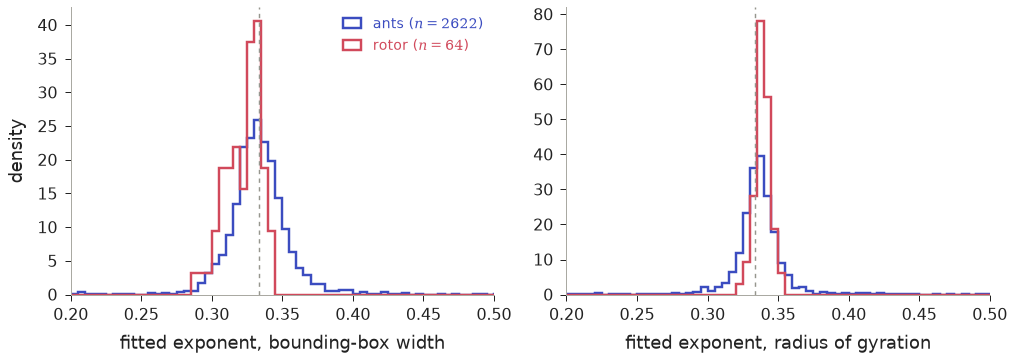
A fitted exponent can look convincing even when the observation window is biased. How do our instruments behave on walkers with known comparison behaviour?
2026-10-13-calib-instrument-calibrationThe ant sees young colours near fresh ground. Does their mixture stabilize enough to support a time-independent growth description?
2026-10-13-c3-edge-colour-sharesThe rotor walker is a comparison model with arrows stored on the grid. Does biasing those initial arrows destroy cube-root growth?
2026-10-13-c2-arrow-biasAn ant can wander for billions of steps before finding a repeating path that carries it away. Does the chance of that late switch stay constant per decade of time?
2026-10-13-b5-late-highwaysSome rules were excluded because the growth fit could not be computed. Were fast-growing ants escaping the board and disappearing from the analysis?
2026-10-13-b4-unfitted-rulesThe first census concentrates on short rules. Does the growth pattern persist when an ant has many more colours to cycle through?
2026-10-13-b3-long-rules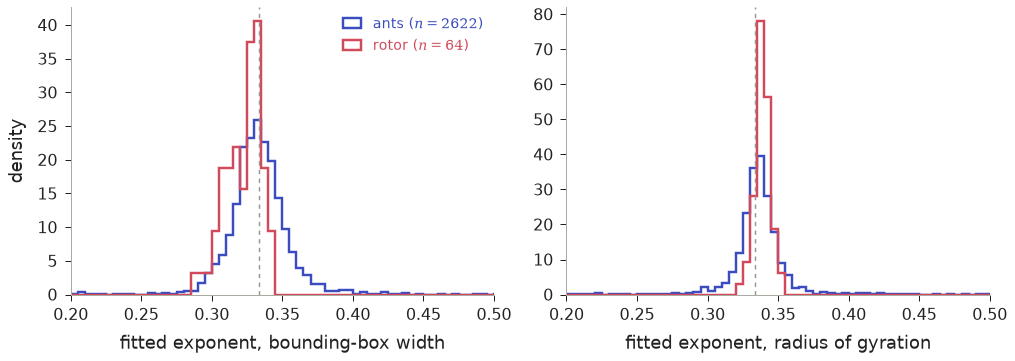
The census shows a distribution of growth exponents. Is that mostly a difference between rules, or variation between starting patterns?
2026-10-13-b2-between-rule-variance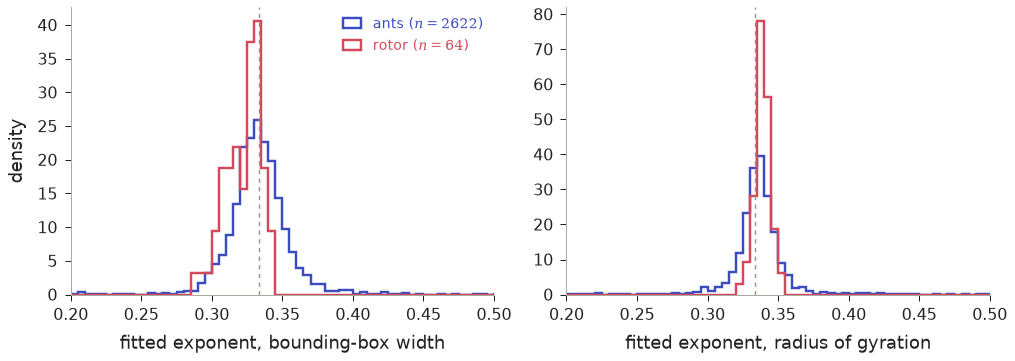
Many chaotic ants appear to grow in width like the cube root of time. Do their apparent differences survive much longer observation?
2026-10-13-b1-exact-exponentCould a shortage of visits in part of the interior explain why different rules reach fresh ground at different rates?
2026-10-13-arm-kappa-depletion-armsFor rule RRLLLLLLR, does changing a small starting patch eventually cease to matter, or do rare trajectories keep the growth coefficient variable?
2026-10-13-a7-rrllllllr-self-averaging
Rare colours are unusually important in tethered territories. Are they important because the ant repeatedly repairs damage there?
2026-10-13-a6-corruption-mechanism
Many tethered ants fall into a small collection of similar home behaviours. Can a simple property of the rule label those groups?
2026-10-13-a5-home-typesAnt and rotor territories can grow at similar rates while their boundaries fluctuate differently. Does the difference disappear in longer runs?
2026-10-13-a4-boundary-width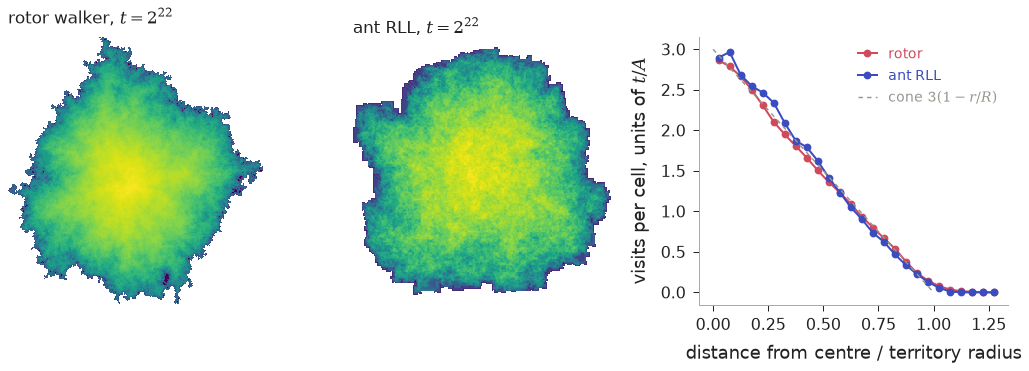
Ants revisit the centre of their territory more than its edge. Does that radial profile reveal a special return mechanism?
2026-10-13-a3-background-cone-controlA compact two-dimensional territory should have a perimeter proportional to the square root of its area. Is the measured excess a temporary effect?
2026-10-13-a2-edge-exponent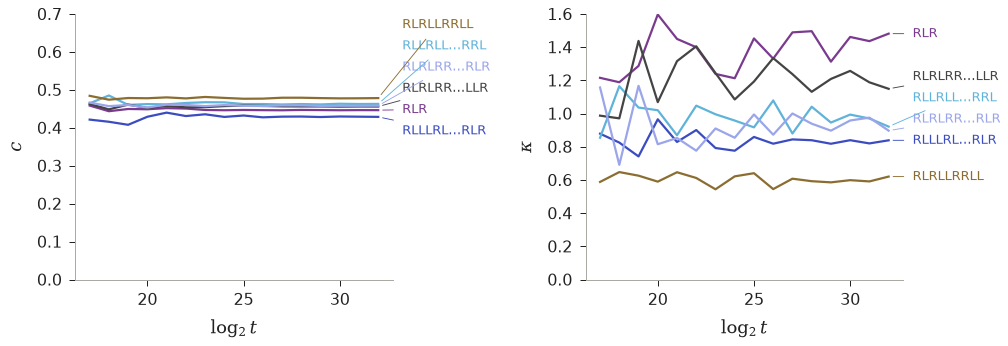
Two ants can have similar territory shapes yet spend different amounts of time near fresh ground. Can simple rule features predict that difference?
2026-10-13-a1-kappa
Some ants repeatedly return to a small home region. Is that behaviour stored in particular patches of the colour pattern they have written?
2026-10-12-knockout-maps