Field notes / Experiment guide
When does the cone-shaped visit profile stop working?
The accumulated cone follows under particular occupation and growth assumptions. Does it survive when noise changes a rotor’s growth law?
New to these ants? Start here.
An ant moves on a grid of coloured squares. Each colour tells it to turn left (L) or right (R). It advances that square to the next colour, then steps forward. A rule such as RLR is the list of turns, starting at colour zero. On a blank grid the same rule always makes the same trajectory.
Territory means every cell visited so far. Its boundary consists of visited cells with an unvisited neighbour. A highway is a repeating pattern of motion that carries the ant away. A tether means repeated returns to a small home region.
Growing like the cube root of time means taking eight times as many steps to double a linear size. The rotor walker is a comparison model that follows and rotates arrows stored on cells. A seed makes a random starting pattern reproducible; the ant itself can still move deterministically.
We distinguish c, the chance of discovering a cell per boundary step, from kappa (κ), time at the boundary normalized by perimeter divided by area. Explaining their values is harder than using them to account for growth.
A closer look
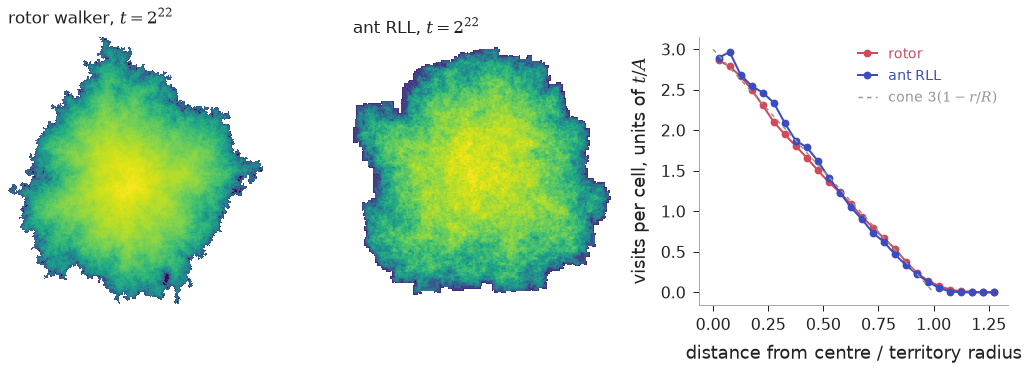
The idea under test
If only the exponent matters, a generalized profile formula should still predict noisy-rotor visit density.
What we learned
Away from the cube-root regime, occupation stops being sufficiently uniform and the proposed formula fails.
What this leaves open
The failure rejects transfer of the assumptions; it does not invalidate the conditional derivation in the regime where those assumptions hold.
Read the evidence and reproduction recipe ↗
Inside the experiment
Methods, registered predictions, exact commands and saved analysis. These are the working research documents; expand them for the detail behind the introduction.
Methods and original experiment record
w3
Migrated legacy investigation (2026-10-14). Its files used to sit in the flat data/ directory (and calib/, occ/, snaps/, dumps*, knock* where listed) with the label prefix below; experiments/_migration/map.tsv gives the exact old -> new path of every file. This stub was generated from file names and script docstrings. It is not the original write-up: the question, timestamped hypotheses, commands and results are in notes/ (mainly notes/frontier-results.md, notes/frontier-status.md, notes/research-frontier*.md; search for the label), and the producing command is usually in the script docstring or a run_*.sh here.
Old labels / prefixes: w3
Scripts
scripts/w3_stats.py: W3: profile of noisy rotors / memoryless walkers at 2^26 vs formula (with own a, k=20..26) and cone. Input experiments/2026-10-13-w3/results/w3_shape.csv. Predi
Results
4 entries in results/ (1 are .log/.done markers); csv/json/txt outputs, *_stats.txt hold the summaries quoted in the notes.
Notebook
No committed Jupyter notebook is available for this experiment yet.