Field notes / Experiment guide
The opening run predicts entry, not simply occupation
Does the start of the rule control boundary time directly, or primarily the chance of stepping onto fresh ground?
New to these ants? Start here.
An ant moves on a grid of coloured squares. Each colour tells it to turn left (L) or right (R). It advances that square to the next colour, then steps forward. A rule such as RLR is the list of turns, starting at colour zero. On a blank grid the same rule always makes the same trajectory.
Territory means every cell visited so far. Its boundary consists of visited cells with an unvisited neighbour. A highway is a repeating pattern of motion that carries the ant away. A tether means repeated returns to a small home region.
Growing like the cube root of time means taking eight times as many steps to double a linear size. The rotor walker is a comparison model that follows and rotates arrows stored on cells. A seed makes a random starting pattern reproducible; the ant itself can still move deterministically.
We distinguish c, the chance of discovering a cell per boundary step, from kappa (κ), time at the boundary normalized by perimeter divided by area. Explaining their values is harder than using them to account for growth.
A closer look
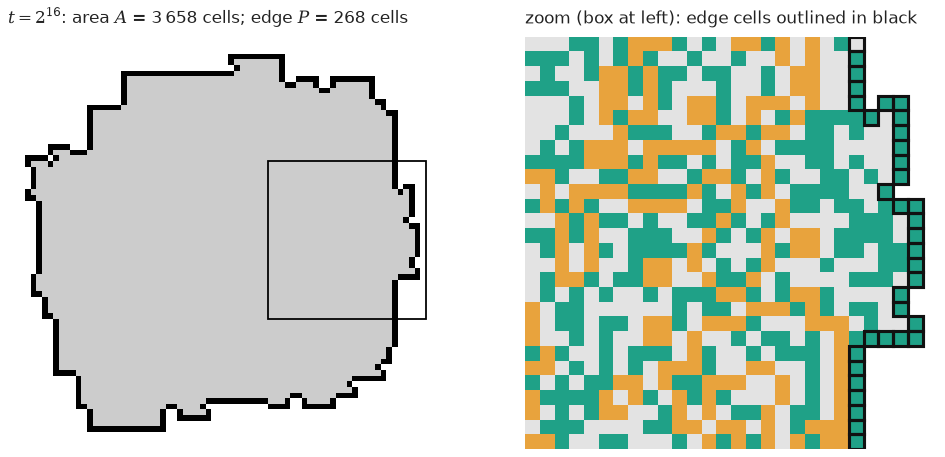
The idea under test
Comparing rotations of the same rule and fresh-rule predictions can distinguish a cyclic rule property from a fresh-ground effect.
What we learned
The cyclic-necklace explanation fails, while opening-run length predicts the inverse fresh-ground entry probability on held-out fresh rules.
What this leaves open
The intercept and slope still need an explanation. Discovery stages reused inspected data, and the unrun stage must not be counted as evidence.
Read the evidence and reproduction recipe ↗
Inside the experiment
Methods, registered predictions, exact commands and saved analysis. These are the working research documents; expand them for the detail behind the introduction.
Methods and original experiment record
kappa and the chiral edge layer: does the opening run act on fresh ground?
Registered 2026-10-19 08:45 (+13:00), base commit 3f23de3, before any analysis of necklace-matched data.
Stage 1 (below) is analysis-only on probe_summary.csv, which has been seen before (K1 ICC, W3 prefix work), but the
within-necklace lead regression has never been run. It is therefore a registered test on seen data (not blind),
and the lead effect itself is known from the cross-section, so only the within-necklace design is new.
Hypothesis (mechanism)
Fresh ground reads colour 0, 1, 2, ... in order, and edge cells are young. With rule R^m L ... a cell turns the
ant the same way on its first m visits. An ant circling on young cells makes a closed 4-step loop (turn, turn, turn,
turn), re-reading those same cells, so it dwells around a newly opened patch for roughly 4m steps instead of
leaving. Picture: bulk is old and near-uniformly coloured (diffusive); the rim is a thin chiral layer whose strength
is the opening same-letter run, like skipping orbits in a magnetic field that acts only at a wall, or the surface
accumulation of persistent (active-Brownian) walkers whose persistence is set at the wall.
Why test this rather than the plans in notes/kappa-mechanisms-2026-10-15.md: it is the mechanistic reading of the
only kappa predictor that has survived fresh data (leading run: L1, L3, A1, M3) and it explains the one unexplained
asymmetry (extending the lead cuts A22) through c, since loop steps are boundary steps that open no new cell:
dA/dt = c kappa P/A with c falling as kappa rises.
Stage 1: within-necklace test (no new runs)
Cyclic rotations of one rule have identical composition and cyclic sequence, and differ only in which colour the blank ground reads first (K1: ICC of ln kappa across rotations is only 0.199, so ~80% of variance is within necklace). If the opening run acts on fresh ground, then within a necklace ln kappa should follow each rotation's own lead. A composition or bulk-cycle explanation predicts no within-necklace slope.
Data: experiments/2026-10-13-probe-growth-census/results/probe_summary.csv, blob class, kappa > 0 (as K1); stationary
subset |g_k| < 0.05 as a sensitivity. lead = length of the opening same-letter run, capped at 6 as in the
leading-run experiment; trail = the closing same-letter run (capped at 6), the control: it is a property of the
same string with the same composition but not read first by fresh ground. Necklaces with >= 2 members of differing
lead. Demean ln kappa, ln c, lead, trail within necklace; pooled within-necklace OLS slope; CIs by bootstrap over
necklaces (2000, seed 20261019).
- N1 slope of ln kappa on lead (within necklace) > 0, bootstrap CI above 0, and >= 0.08 per step (cross-section 0.15-0.2; allowing for dilution by the cap and by rotations that fall outside the blob class). ~70%.
- N2 slope of ln c on lead < 0 with CI below 0 (loops are boundary steps that open no cells). ~55%.
- N3 control: |slope of ln kappa on trail| < 0.5 x slope on lead, and its CI includes 0 or is smaller in magnitude than the lead CI's lower bound. ~65%.
- N4 within-necklace R^2 of the lead term >= 0.05 for ln kappa. ~60%.
- N5 (descriptive, no threshold) repeat on stationary rules only, and with lead uncapped.
Decision rule. N1 fails => the lead effect is not a fresh-ground effect at fixed cyclic content in the census (composition/bulk-cycle or area-proxy reading wins) and Stage 2 is not run. N1 holds and N3 holds => proceed to Stage 2. N2 failing while N1 holds means the c-mediated story (loops as non-opening boundary steps) is wrong even if lead matters, to be reported as such.
Stage 2 (proposed, not yet registered)
Background dose-response with the rule fixed, sbg:RULE:SEED:DENSITY, then a micro-observable (fraction of
boundary steps inside same-turn runs of length >= 4, dwell per new cell). Registered separately after Stage 1.
Commands (WSL, repo root)
uv run experiments/2026-10-19-kappa-chiral-edge/scripts/necklace_lead.py # results/necklace_lead.{txt,json}
Stage 1 results (run 2026-10-19 ~08:55, commit 3f23de3, seed 20261019, 2000 necklace bootstraps)
results/necklace_lead.{txt,json}. All blob: 536 necklaces / 2358 rules. Stationary: 474 / 1891.
| pred | outcome |
|---|---|
| N1 slope ln kappa on lead >= 0.08, CI > 0 | FAILED: all blob -0.007 [-0.037, 0.017]; stationary +0.044 [0.027, 0.060] (~1/4 of the cross-sectional 0.15-0.2, still below 0.08) |
| N2 slope ln c on lead < 0 | HELD, much stronger than expected: -0.243 [-0.249, -0.237], within-necklace R^2 0.83 (stationary -0.228, R^2 0.86) |
| N3 trail control | moot (N1 failed); trail slope on ln kappa +0.013 [-0.013, 0.039] all, +0.022 stationary |
| N4 R^2 >= 0.05 for ln kappa | FAILED: 0.000 (all), 0.026 (stationary) |
Per the decision rule Stage 2 (sbg dose-response) is NOT run. Reading: at fixed cyclic content the fresh-ground opening run barely moves kappa; it moves c (births per boundary step) almost deterministically. The edge-layer loop picture is right about c and wrong about kappa. The cross-sectional lead-kappa association therefore must come mostly from between-necklace content correlated with lead.
Stage 1b (registered 2026-10-19 09:05, before running; census data again)
Hypothesis: that content is the longest cyclic same-letter run M (max over the necklace, cyclic, = max over rotations of lead), a bulk-cycle property: a run of M same-turn colours makes any cell, at any age, loop for M reads. Stationary blob rules, capped at 6 for both.
- M1 R^2 of ln kappa on M exceeds R^2 on lead (OLS, same rules), and M's R^2 >= 0.05.
- M2 with both in one regression the lead coefficient falls to < 50% of its lead-only value, M's coefficient > 0.
- M3 necklace-level: necklace mean ln kappa on M, slope > 0 with necklace-bootstrap CI above 0.
(Confound I know of: M, rule length and ln A(22) are all correlated; no area control in this stage, so a positive
result is "kappa follows cyclic run content", not a clean causal claim.) Script
scripts/cyclic_run.py.
Stage 1b result (run 2026-10-19 ~09:10; results/cyclic_run.txt, stationary blob, 2185 rules, 625 necklaces)
M1 FAILED (R^2 M 0.033 < 0.05; and census-wide ln kappa on lead has R^2 0.001, slope +0.010: the lead-kappa
association exists only after conditioning on ln A(22), see leading-run experiment). M2 FAILED (lead coefficient
rises, ratio 4.28, when M is added). M3 FAILED, wrong sign (necklace-level slope -0.071 [-0.088, -0.053]).
Cyclic-run content does not explain it. Descriptive results/c_by_lead.txt (post hoc, seen before registering
Stage 3): c is nearly a function of lead: mean c 0.487, 0.374, 0.297, 0.242, 0.208, 0.181 for lead 1..6, sd within
lead 0.07 (lead 1) falling to 0.015, and 1/c grows ~linearly (2.09, 2.69, 3.38, 4.15, 4.83, 5.57).
Back-of-envelope: with total d ln kappa/d lead ~ 0, b ~ +0.15 at fixed area, d ln A22/d lead ~ -0.3 (M-series) implies
d ln kappa/d ln A ~ +0.5 (partly definitional, kappa = B A / P): the lead effect on kappa is a conditional-on-area
effect that cancels against lead's effect on growth via c. Unverified.
Stage 3: lead sets the edge birth rate c (registered 2026-10-19 09:25, before computing anything on fresh rules)
Reframed hypothesis: at the growing edge the ant reads young cells; the opening run m is the number of consecutive
same-turn reads, so it sets the number of boundary steps per birth, 1/c ~ a + b m. The naive 2x2-loop picture
predicts a = 0, b = 1 (each new 2x2 block costs 4m steps for 4 births); the census table already shows b ~ 0.7, so
that naive picture is stated here as expected to FAIL in b, and kept as a reference.
Fit on census only (stationary blob, probe_summary.csv, 1/c = a + b min(lead,8), OLS on 1/c), then predict fresh rules
(2026-10-16-kappa-leadrun-fresh/results/fresh_rules.csv, kept & stationary, lengths 13-14, never used in the fit,
c measured by the same probe, 8 seeds averaged, so noisier than census):
- C1 out-of-sample R^2 of predicted vs observed c >= 0.75 and median |relative error| <= 0.08. ~75%.
- C2 fresh refit slope b (OLS, bootstrap CI over rules, 2000, seed 20261019) contains census b. ~65%.
- C3 naive-loop test: census b outside [0.85, 1.15] (i.e. naive picture rejected). ~85%.
- C4 residual structure: after lead, the next letters matter. Census, random half split (seed 20261019): lookup on first 4 letters, fitted on
half A, scored on half B, held-out R^2 for ln c >= 0.92 (lead-only ~0.84), and a prefix-6 lookup adds <= +0.02 beyond prefix-4. ~55%.
Script
scripts/c_law.py.
Stage 3 results (run 2026-10-19 ~09:35, commit 3f23de3, seed 20261019; results/c_law.{txt,json})
Census fit (stationary blob, n = 2185): 1/c = 1.363 + 0.696 lead. Fresh (kept + stationary, n = 176, lengths 13-14, not used in the fit):
| pred | outcome | |---|---| | C1 R^2 >= 0.75, median rel err <= 0.08 | HELD: R^2 0.877, median |rel err| 0.041. Per-lead means track within 0.02 (0.504/0.371/0.300/0.247/0.208/0.186 observed vs 0.486/0.363/0.290/0.241/0.206/0.181 predicted) | | C2 fresh b CI contains census b | HELD: fresh 1/c = 1.335 + 0.683 lead, b CI [0.658, 0.707] vs 0.696 | | C3 census b outside [0.85, 1.15] | HELD (b = 0.696): the naive 2x2-loop picture (a = 0, b = 1) is rejected | | C4 prefix-4 lookup R^2 >= 0.92 and prefix-6 adds <= 0.02 | FAILED: held-out R^2 of ln c is 0.842 lead-only, 0.845 / 0.887 / 0.924 / 0.950 for prefix 4 / 5 / 6 / 8 lookups. Information keeps accumulating with each early letter; no sharp cutoff at 4 |
Exploratory, unregistered (scripts/c_explore.py, results/c_explore.txt): a linear model of 1/c on pairwise alignments
s_0 s_j of the first K letters is worse than the single lead (fresh R^2 0.81 vs 0.877), with weights decaying as
0.64, 0.36, 0.24, 0.09, 0.02: the run structure (a chained product) matters, not pairwise alignment.
Status and verdict (2026-10-19)
- The registered kappa hypothesis (the opening run, as a fresh-ground chiral edge layer, raises kappa) is refuted at the census scale: within a necklace at fixed cyclic content the lead slope is ~0 (all blob) or 0.044 (stationary, a quarter of the cross-section); the cyclic-maximum-run alternative also fails (wrong sign).
- Reinterpretation the data support: the opening run sets the birth rate c almost deterministically (1/c = 1.36 + 0.70 lead, out-of-sample R^2 0.88). Because dA/dt = c kappa P/A, a higher lead slows growth without, on average, changing kappa. The earlier "lead effect on kappa" is a conditional-on-ln A(22) effect (census-wide kappa vs lead R^2 = 0.001). Whether it is residual structure from conditioning on a variable that lead itself drives (here via c) or a genuine fixed-area effect is NOT decided; the M3 result of the leading-run experiment (shortening the lead lowers ln kappa at unchanged area) still stands.
- Unexplained: why b ~ 0.70 and a ~ 1.36 (not 1 and 0), why c keeps gaining from letters 4-8, and the fact that kappa >~ 1 for lead >= 6 (small n: 22, 6, 4).
- Not done: Stage 2 sparse-background dose-response (gated on N1, which failed). It would still be the cleanest way to ask whether c's lead dependence really is a fresh-ground effect: prediction would be b falling toward 0 as background density rises. Not registered.
Follow-up (added 2026-10-19, after the close of this experiment)
The open items above (mechanism of a ~ 1.36 and b ~ 0.70, the unregistered sbg dose-response, and whether the kappa shift at fixed ln A22 is real) were taken up in
experiments/2026-10-19-c-law-mechanism (own registrations, results and notebook). Nothing registered or reported here is changed by it.
Analysis notebook: notebook.ipynb
No saved outputs. This render shows the saved narrative and code; cells have not been executed for publication. Download notebook
kappa and the chiral edge layer
Question: does the opening same-letter run (lead) raise kappa by acting on fresh ground? Registered in README before each stage; reads only committed results/.
Verdicts: within-necklace lead to ln kappa ~ 0 (N1/N4 failed); cyclic max run fails (M1-M3); lead sets c: 1/c = 1.363 + 0.696 lead, out-of-sample R2 0.877 on 176 fresh rules (C1-C3 held, C4 failed). Mechanism of intercept/slope open. Caveats: census data seen before (K1, W3); Stage 1/1b not blind; Stage 2 not run; fresh c is an 8-seed mean.
Code
import pathlib
root = pathlib.Path(".").resolve()
while not (root/"AGENTS.md").exists(): root = root.parent
r = root/"experiments/2026-10-19-kappa-chiral-edge/results"
for f in ["necklace_lead.txt","cyclic_run.txt","c_by_lead.txt","c_law.txt","c_explore.txt"]:
    print("=====", f); print((r/f).read_text())
Provenance: commands in README; seed 20261019; base commit 3f23de3; inputs probe_summary.csv (census), fresh_rules.csv (leading-run experiment).
Next: sbg dose-response of the c law; flat-edge strip enumeration for slope 0.70 and intercept 1.36.
Read the dated lab log
Lab notebook: kappa and the chiral edge layer
Append-only. Newest entry last. Never edit an old entry; correct it with a new one
(corrects: <timestamp>). Tags: intent, assumption, observation, interpretation,
surprise, decision, dead-end, question, deviation. See experiments/README.md.
2026-10-19 08:40 (+13:00) · 3f23de3 · intent
Goal: investigate a promising mechanism for kappa. Read notes/open-questions-hypotheses.md and kappa-mechanisms-2026-10-15.md. The only predictor that survived fresh data is the leading run (L1, L3, A1, M3), but causality is unestablished (M1/M2 failed because lengthening the lead also cuts A22). Chosen hypothesis: the opening run acts on fresh ground as a chiral edge layer (m same-turn reads of a young cell = a 4-step loop, dwell ~4m), a wall-localised persistence in the sense of active-matter wall accumulation / skipping orbits. Advisor-suggested design: first a within-necklace test (rotations keep composition and cyclic sequence, change only what fresh ground reads first), on existing census data; then SparseBg dose-response with rule fixed. README registers N1-N5 before the analysis runs.
2026-10-19 08:46 (+13:00) · 3f23de3 · assumption
K1 says only ~20% of ln kappa variance lies between necklaces (ICC 0.199), so there is plenty of within-necklace variance for lead to explain. Not verified that rotations' lead varies enough inside necklaces; the script drops necklaces whose members all have the same capped lead and reports the count. Also: lead and trail are anticorrelated within a necklace when the cut falls inside a run, so N3 uses the marginal trail fit and I additionally report lead+trail jointly (descriptive).
2026-10-19 08:50 (+13:00) · 3f23de3 · deviation
First launch of necklace_lead.py failed (script not written because the combined command was refused by the harness; then WSL path/$HOME quoting under PowerShell). Fixed by writing the script with the editor tool and passing the command in single quotes. No analysis output was seen before the successful run.
2026-10-19 09:00 (+13:00) · 3f23de3 · observation (results/necklace_lead.txt)
Within-necklace slope of ln kappa on lead: -0.007 [-0.037, 0.017] (all blob, 536 necklaces, 2358 rules), +0.044 [0.027, 0.060] stationary (474 / 1891). Within-necklace slope of ln c on lead: -0.243 [-0.249, -0.237], R^2 0.83 (stationary -0.228, 0.86). N1 and N4 FAILED, N2 HELD, N3 moot.
2026-10-19 09:02 (+13:00) · 3f23de3 · surprise
ln c is almost a deterministic function of the opening run within a necklace (R^2 0.83). I expected c to fall but not by this much. The kappa edge-layer picture is wrong at the census level; the c part is right.
2026-10-19 09:12 (+13:00) · 3f23de3 · observation (results/cyclic_run.txt)
Registered Stage 1b (cyclic max run M): M1, M2, M3 all FAILED. Census-wide ln kappa on lead R^2 0.001 slope +0.010; M slope -0.056. So the lead effect on kappa appears only conditional on ln A(22).
2026-10-19 09:20 (+13:00) · 3f23de3 · interpretation
Lead drives c; c drives growth and so A22 (via dA/dt = c kappa P/A); kappa at fixed A22 shifts with lead (+0.15/step) while kappa total does not. Implies d ln kappa/d ln A ~ +0.5, part of it definitional (kappa = B A/P). So the earlier "lead raises kappa" is a conditional statement; conditioning on a variable the predictor itself moves (here via c) makes the sign of any "effect" depend on that choice. Confidence moderate: the conditioning argument is arithmetic from numbers in earlier notes, not re-measured here. Alternatives: genuine fixed-area edge effect (M3 supports), selection (L5).
2026-10-19 09:36 (+13:00) · 3f23de3 · observation (results/c_law.txt)
Registered Stage 3: C1 held (fresh R^2 0.877, rel err 0.041), C2 held (b 0.683 [0.658, 0.707] vs census 0.696), C3 held (naive loop b = 1 rejected), C4 FAILED (prefix lookups keep gaining: 0.845 / 0.887 / 0.924 / 0.950 at 4 / 5 / 6 / 8). Exploratory linear alignment model worse than lead (0.81).
2026-10-19 09:40 (+13:00) · 3f23de3 · decision
Stop here for the kappa claim; write up, update notes and commit. Reason: the pre-registered kappa mechanism is refuted and the replacement (lead -> c law) is a strong, validated empirical regularity, but its mechanism (a = 1.36, b = 0.70) is unexplained. Next experiment, unregistered: sbg density dose-response for the c law; and an exact edge-strip enumeration for b.
2026-10-19 09:41 (+13:00) · 3f23de3 · question
Is b = 0.70 derivable from a flat-edge scattering calculation (young cells coloured 1..m, ant arrives with random heading)? Why does the fit give kappa >~ 1.25-1.5 at lead 7-8 (n = 6, 4)?
2026-10-19 19:06 (+13:00) · b7b4758 · decision
Follow-up opened in experiments/2026-10-19-c-law-mechanism (the open questions above: where 1.36 and 0.70 come from, the sbg dose-response, and whether the fixed-area kappa shift is real). Nothing in this experiment's results is revised by that work; its outcomes are recorded there and summarised in notes/open-questions-hypotheses.md. In one line: the fixed-area lead effect on kappa was reproduced by conditioning on ln A22 with no direct effect (collider), the sbg dose-response was run, and the flat-edge simulation reproduces the c law rule by rule.